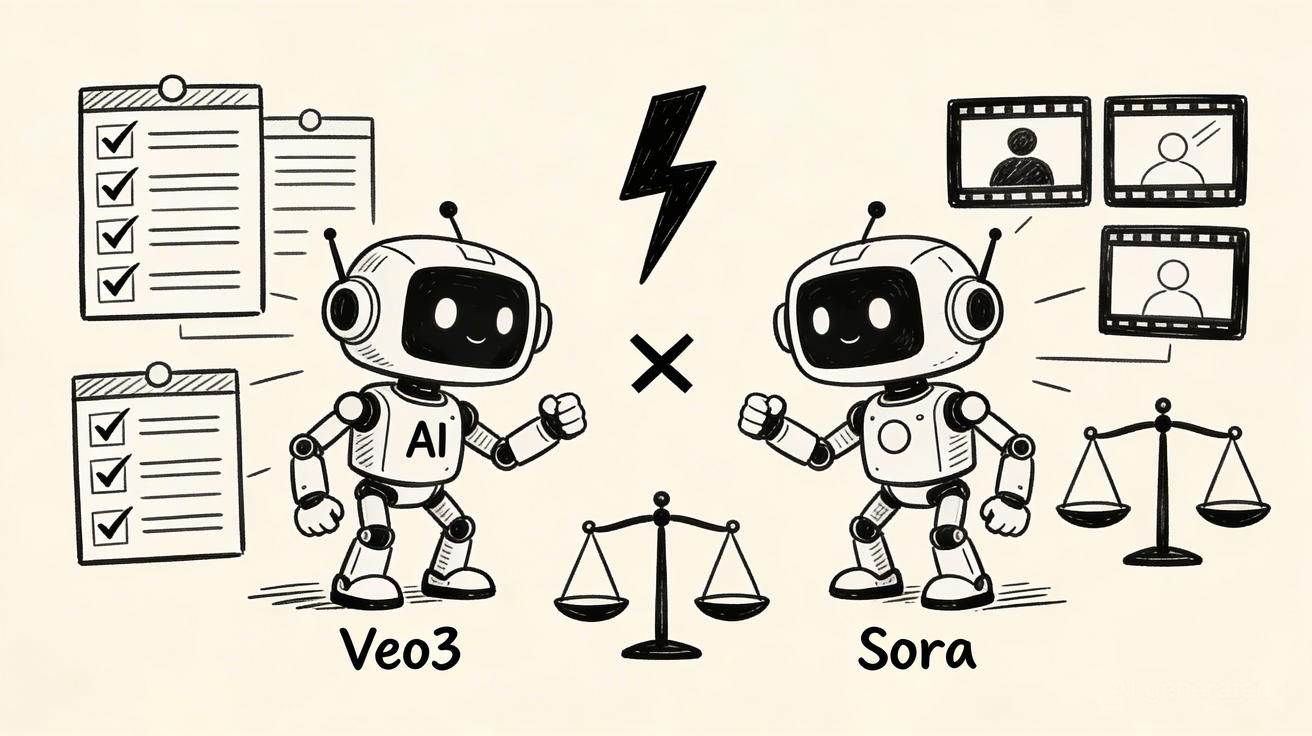
The landscape of generative video has shifted dramatically. As of 2026, the rivalry between Google DeepMind and OpenAI has reached a fever pitch. For creators using the VeoNano framework, choosing between Google Veo 3 and OpenAI Sora is no longer about hype—it’s about technical precision and workflow integration.
The State of Both Models in 2026
To understand the current market, we must look at the maturity of these platforms. Google Veo 3 arrived in mid-2025 and has undergone rapid iteration, cementing its place within the Google ecosystem. Meanwhile, Sora moved from its exclusive preview phase to general availability in late 2024, establishing a massive footprint among creative professionals.

Visual Quality and Realism: A Head-to-Head
When it comes to raw photorealism, Veo 3 holds a slight edge. Leveraging DeepMind’s extensive research into visual foundation models, Veo 3 produces cinematic outputs that excel in high-fidelity detail.
A major differentiator in 2026 is physical accuracy. Veo 3 demonstrates a superior grasp of real-world physics. Whether it is the complex way light caustics move through water, the specific drape of cloth, or the chaotic dynamics of fire, Google’s scientific computing background gives it a more "grounded" feel compared to Sora’s more stylized, though still impressive, outputs.
Temporal Consistency and Resolution
Temporal consistency—the ability for characters and environments to remain stable across a scene—has historically been the "Achilles' heel" of AI video.
- Veo 3: Wins decisively on resolution and length. It offers native 4K output, making it the preferred choice for professional production workflows that require high-resolution assets. It also leads in single-clip duration.
- Sora: While highly consistent, it often trails in raw resolution benchmarks compared to Veo 3’s 4K capabilities.
Features and Creative Control
The choice between these tools often comes down to how much control you need over the "camera."
- Technical Precision (Veo 3): Veo 3 introduces explicit camera parameters. Users can direct the AI using specific commands for dollies, pans, tilts, zooms, and even "handheld" versus "static" shots. This level of granular control is available via VideoFX and API, making it a powerhouse for technical directors.
- Creative Iteration (Sora): Sora shines in the "ideation" phase. Its "Blend" and "Storyboard" tools are widely considered more intuitive for artists who want to iterate quickly on a concept rather than fine-tune a camera angle.
Both models have successfully integrated synchronized audio generation, allowing creators to generate soundscapes that match the visual action in a single workflow.
The Verdict: Which Is Better?
The "better" model depends entirely on your specific application:
- For Professional Cinematography: Veo 3 is the winner. Its 4K resolution, physical accuracy, and manual camera controls make it indispensable for high-end production.
- For Creative Storyboarding: Sora remains the gold standard for intuitive creative tools and rapid prototyping.
- For Social Media and General Content: It is a draw. Both support all standard aspect ratios and offer competitive pricing models in 2026.
The Bottom Line for VeoNano Creators
To scale your content effectively, you must standardize your production. Use Veo 3 when you need "final-pixel" quality for high-stakes projects, and lean on Sora when the creative "vibe" and speed of iteration are your primary goals.
Next Step
Optimize your production pipeline with VeoNano workflow templates.
Frequently Asked Questions
Which model produces higher resolution video?
In 2026, Veo 3 is the leader in this category, offering native 4K output which is a significant advantage for professional editors and filmmakers.
Can I control the camera movement in these AI tools?
Yes, specifically in Veo 3. It offers direct parameters for pan, tilt, zoom, and dolly shots, providing a level of control that mimics traditional cinematography.
Does Sora or Veo 3 include audio?
Both models now feature integrated video-to-audio capabilities, ensuring that the generated sound effects and atmospheres are synced with the visual motion.
Which is better for realistic physics?
Veo 3 currently holds the advantage in simulating natural phenomena like fluid dynamics and light caustics due to Google’s advancements in scientific computing.