Categories: AI Video Workflow, Creator Strategy, Production Process
Tags: veonano, ai creation studio, ai video workflow, content strategy, creator toolkit
Introduction
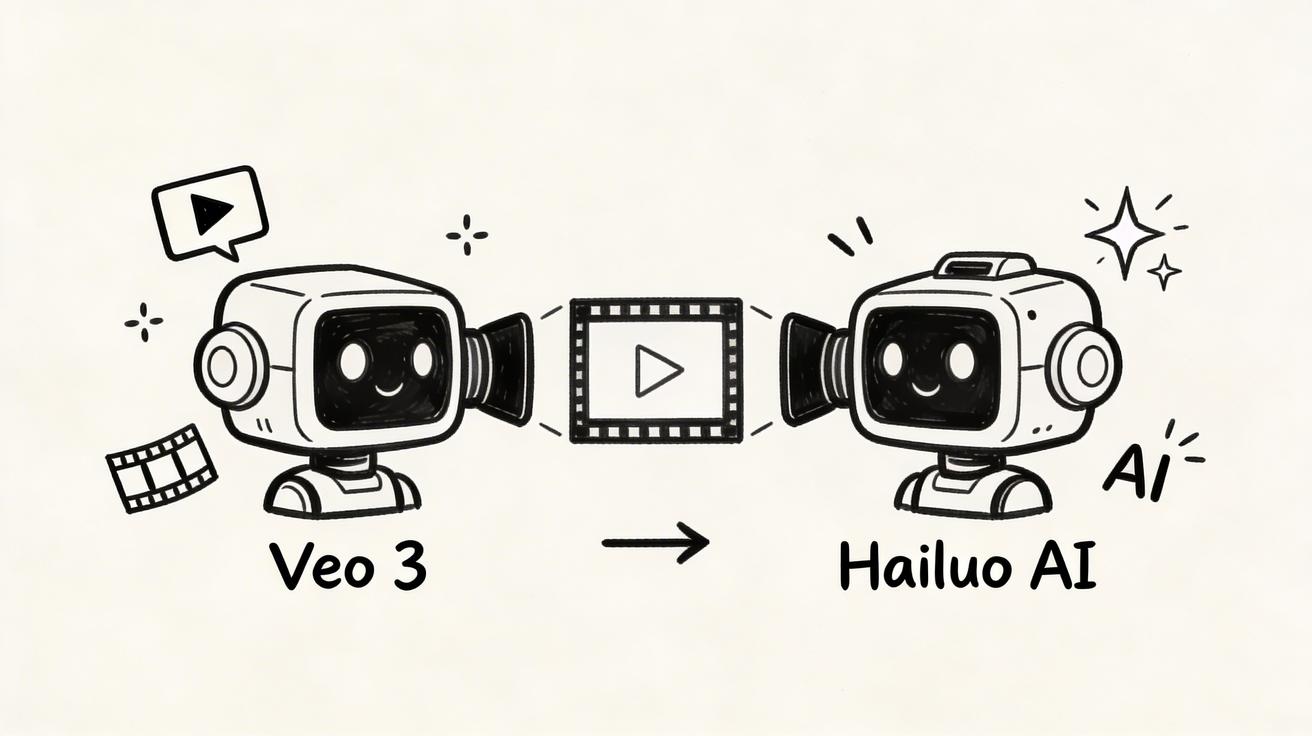
As we move through 2026, the landscape of AI video generation has matured into a battle between cinematic precision and accessible agility. At VeoNano, we focus on helping creators integrate these powerful tools into a repeatable production framework. This guide breaks down the critical differences between Google’s Veo 3 and MiniMax’s Hailuo AI to help you decide which engine should power your next project.
Quick Comparison: Veo 3 vs Hailuo AI
Veo 3 stands as Google DeepMind’s premier video generation model. Integrated into the Google Vertex AI ecosystem and accessible via the Google Flow platform, it is designed for high-end creative professionals who require deep integration with existing cloud workflows.
Hailuo AI, developed by the startup MiniMax, has carved out a significant market share by focusing on fluid motion and subject consistency. Since its breakout in late 2024, it has become the go-to for creators who need high-quality results without the overhead of enterprise-grade ecosystems.
Video Quality and Resolution
When it comes to pure visual fidelity, Veo 3 is the current industry benchmark. It delivers native 4K output with a level of photorealism and physics accuracy that remains difficult to match. For projects requiring cinematic camera controls and intricate environmental details, Veo 3 is the superior choice.
Hailuo AI is highly competitive in the 1080p space. While it lacks the 4K resolution of its rival, it excels in motion smoothness and maintaining the likeness of subjects across different frames. It is particularly effective for portrait animations and social-first content where 1080p is the standard delivery format.
Audio and Integrated Features
The gap between the two platforms widens when looking at native audio capabilities. Veo 3 offers a more holistic "video-first" experience, integrating audio generation directly into the workflow. This makes it a decisive winner for filmmakers and high-end advertisers who need a synchronized, professional-grade output from a single prompt.
Pricing and Accessibility
This is where Hailuo AI takes the lead. Positioned as a creator-friendly platform, Hailuo offers a functional free tier and significantly more affordable subscription plans. For independent creators or those managing tight production budgets, Hailuo provides exceptional value for the quality it produces.
In contrast, Veo 3 is priced as a professional-grade tool. Its cost reflects its positioning within the Google Vertex AI ecosystem, targeting studios and enterprises that prioritize 4K resolution and cinematic control over low-cost experimentation.
Speed and Workflow Integration
- Speed: Hailuo AI generally wins on pure generation speed, making it ideal for rapid prototyping and social media iteration.
- Workflow: Veo 3 wins on ecosystem integration. For teams already utilizing Google Flow or Vertex AI, the ability to move assets through a unified pipeline is a massive productivity booster.
- Prompt Adherence: Both models utilize advanced queue systems, though Veo 3 tends to follow complex cinematic instructions with higher precision.
Which Should You Choose?
Choose Veo 3 if you are focused on:
- 4K cinematic production.
- Native audio integration.
- Professional-grade camera controls and physics.
- Enterprise-level ecosystem integration.
Choose Hailuo AI if you are focused on:
- Social media content and portrait animation.
- Budget-conscious production with a high-quality free tier.
- Fast turnaround times and smooth motion.
- High subject consistency at 1080p.
The VeoNano Production Framework
To get the most out of these tools, we recommend a standardized weekly workflow:
- Define Objectives: Choose your platform based on the required output resolution (4K vs 1080p).
- Drafting: Use Hailuo AI for rapid storyboarding and motion testing.
- Final Polish: Move to Veo 3 for high-fidelity final renders if the project demands 4K.
- Measure: Track which platform yields better engagement or faster approval cycles for your specific niche.
Frequently Asked Questions
1) Can I use Hailuo AI for professional work?
Absolutely. While it tops out at 1080p, its motion smoothness is world-class, making it perfect for digital marketing and social media campaigns.
2) Is Veo 3 available to individual creators?
Yes, though it is accessed through Google’s professional platforms like Vertex AI and Google Flow, which may have a steeper learning curve than Hailuo’s standalone interface.
3) Which platform is better for "talking head" videos?
Hailuo AI currently holds an edge in portrait animation and subject consistency, making it a favorite for character-driven content.
Next Steps
Optimize your AI video production by exploring VeoNano workflow templates.
Media References
- https://cdn.veonano.com/blog/veo-3-vs-hailuo-ai-2026/20260403132202-vwsoqaj0.jpeg
- https://cdn.veonano.com/blog/veo-3-vs-hailuo-ai-2026/20260403132204-35g9imd4.jpeg
- https://cdn.veonano.com/blog/veo-3-vs-hailuo-ai-2026/20260403132205-er9re0pb.jpeg
- https://cdn.veonano.com/blog/veo-3-vs-hailuo-ai-2026/20260403132205-rf4kkxod.jpeg