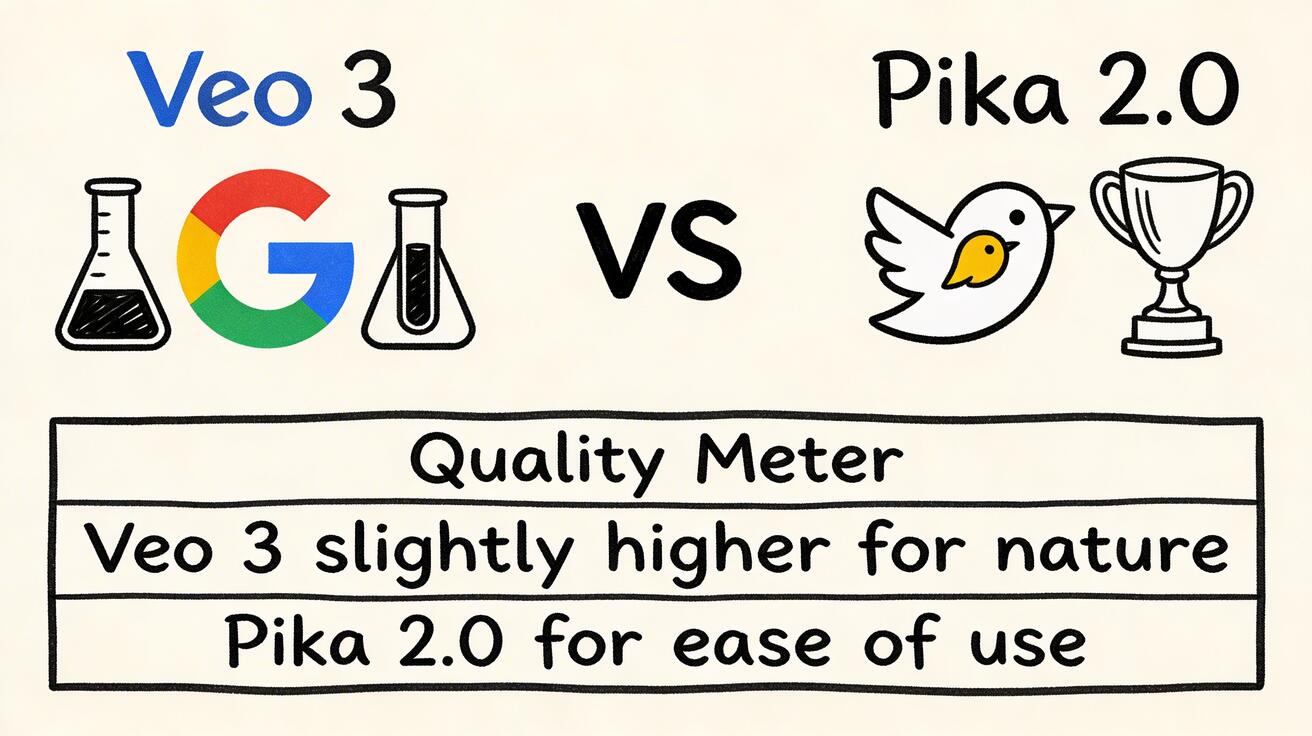
The landscape of AI video generation has shifted dramatically in 2026. Choosing between Google’s powerhouse model and consumer favorites like Pika requires a deep dive into physical realism, rendering speed, and cost-efficiency. This guide breaks down how Veo 3 and Pika 2.0 perform in real-world production environments.
Quick Verdict: Which Model Wins?
After extensive testing, Veo 3 emerges as the overall winner for professional-grade output. It offers superior visual quality, a more generous free tier, and faster generation times. However, Pika 2.0 remains a top contender for social media creators who prioritize ease of use and unique cinematic "Pikaffects."
Background: The Technology Behind the Tools
Veo 3 is the latest evolution from Google DeepMind’s research program. It leverages advanced physical simulation principles to ensure that movement—from flowing water to human gestures—looks naturally grounded in reality. You can access these capabilities directly through the VeoNano platform.
Pika 2.0, developed by the team that raised $55M to democratize video creation, focuses on accessibility. Since its 2023 inception, Pika has specialized in tools for the "prosumer," making it a favorite for TikTok and Instagram creators who need quick, stylized edits without a steep learning curve.
Quality Testing: Head-to-Head Results
We put both models through four distinct prompts to measure their versatility.
1. Nature & Outdoor Scenes
Prompt: "Misty rainforest at dawn, morning light filtering through ancient trees, ground fog, lush green, slow tracking shot" Veo 3 dominated this category. Its ability to handle complex lighting and realistic physics made the fog and light rays feel volumetric, whereas Pika occasionally struggled with the consistency of the "slow tracking" motion.
2. Quick Social Media Clips
Prompt: "Colorful confetti explosion, slow motion, bright and energetic, clean white background" Pika 2.0 excelled here. Its engine is tuned for high-energy, vibrant content that pops on mobile screens. While Veo 3 was more "realistic," Pika’s version felt more "commercial-ready."
3. Portrait & Human Subjects
Prompt: "Professional businesswoman in modern office, confident expression, soft window light, medium shot" Veo 3’s integration of Google’s leading AI research shows in its facial rendering. The skin textures and micro-expressions were significantly more lifelike than Pika’s, which can sometimes lean toward a "filtered" aesthetic.
4. Product Animation
Prompt: "Premium skincare product on marble surface, dramatic lighting, slow rotation, beauty commercial style" Veo 3 is the clear choice for product renders. The physical realism ensures that reflections on the marble and the glass of the bottle react accurately as the object rotates.
Feature Comparison & Pricing
| Feature | Veo 3 (via VeoNano) | Pika 2.0 |
|---|---|---|
| Physical Realism | Superior (DeepMind Physics) | Good (Stylized) |
| Ease of Use | Simple & Streamlined | Highly Polished UX |
| Special Features | High-speed rendering | Pikaffects (Cinematic FX) |
| Free Tier | Generous (Daily Renewals) | Limited Credits |
While pricing is roughly comparable across paid tiers, Veo 3 offers better long-term value for power users due to its daily credit renewal system and higher baseline quality on the free tier.
Practical Recommendation by Creator Type
- For Professional Filmmakers & Marketers: Stick with Veo 3. The physical realism and consistency are essential for high-stakes commercial work.
- For Social Media Influencers: Pika 2.0 is often the faster route to a "viral" look, thanks to its user-friendly interface and built-in effects.
- For the Budget-Conscious: Use both. By combining the free tiers of Veo 3 and Pika, you can access a wide range of styles without an upfront investment.
Conclusion
Scaling your video content in 2026 requires a standardized workflow. By using Veo 3 for your heavy-duty realistic scenes and Pika 2.0 for stylized social clips, you can maintain a high publishing frequency without sacrificing quality.
Next Step: Ready to streamline your production? Explore VeoNano workflow templates to start building your next project.
FAQs
1) Is Pika 2.0 easier to use than Veo 3? Yes. Pika has invested heavily in a consumer-friendly interface that feels very intuitive for casual creators, though VeoNano provides a similarly streamlined experience for Veo 3.
2) Which model is better for realistic physics? Veo 3 is significantly stronger in simulating complex natural scenes, such as fluid dynamics, hair movement, and environmental lighting.
3) Can I use these tools for free? Both offer free tiers. Veo 3 is particularly notable for its daily credit renewals, making it more sustainable for long-term free use compared to Pika’s credit-limited model.
Media References
- https://cdn.veonano.com/blog/veo-3-vs-pika-2-comparison-2026/20260403113600-4jtruqsi.jpeg
- https://cdn.veonano.com/blog/veo-3-vs-pika-2-comparison-2026/20260403113601-2w69chf2.jpeg
- https://cdn.veonano.com/blog/veo-3-vs-pika-2-comparison-2026/20260403113602-j3843uks.jpeg
- https://cdn.veonano.com/blog/veo-3-vs-pika-2-comparison-2026/20260403113603-q9rlflwf.jpeg