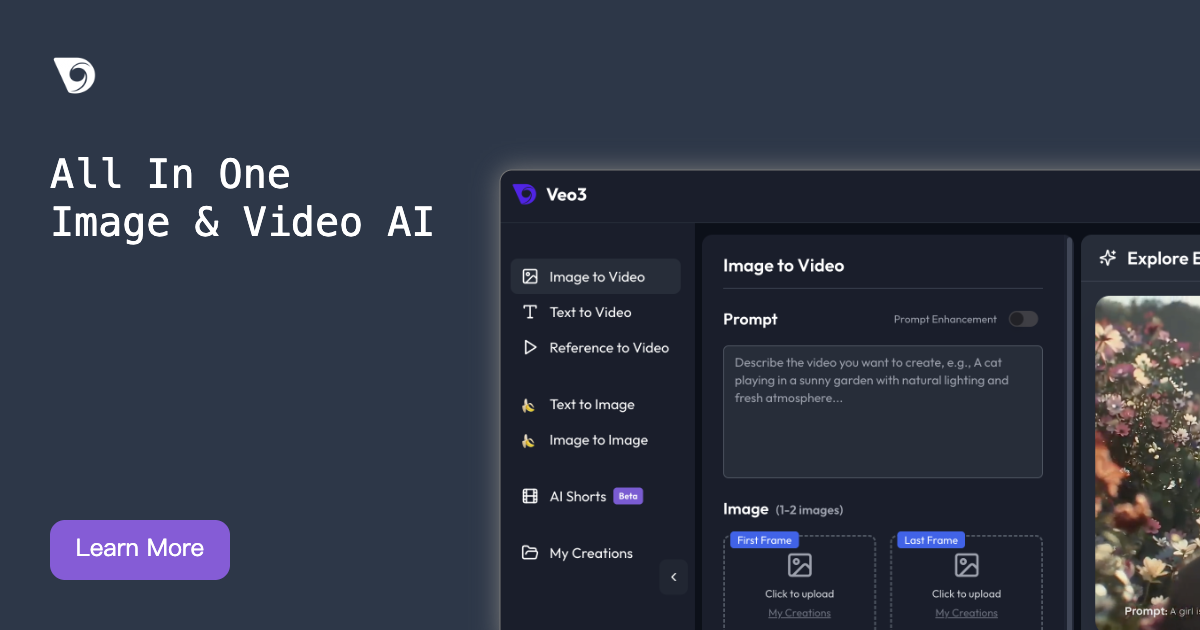
The two most discussed AI video models in 2025 and 2026 are Google's Veo 3 and OpenAI's Sora. Both aim at photorealistic text-to-video generation, but the tradeoffs are different once you compare output quality, audio support, access, and price.
Quick Verdict: Why Veo 3 Takes the Lead
The source article's quick verdict favors Veo 3 overall:
- Video quality: Veo 3, by a slight edge
- Audio generation: Veo 3, because Sora does not offer native audio generation
- Free access: Veo 3, through Google AI Studio
- Long-form coherence: Veo 3
- Creative control: Sora
- Availability: roughly a tie, because both are still limited
- Price/value: Veo 3, especially at the consumer tier
That is why the overall winner lands on Veo 3: better practical output, built-in audio, and a stronger value story.
Quality and Creative Composition
The quality difference is real, but it depends on the kind of scene you want:
- Veo 3 strengths: native audio-video sync, stronger photorealism, longer coherent clips in the 30 to 60 second range, and more immediately usable footage.
- Sora strengths: more stylized output options, stronger complex composition, and better handling of some multi-character scenes.
For most standard creator and marketing use cases, Veo 3 produces results that are easier to ship. Sora remains more interesting when the priority is creative composition rather than production efficiency.
Access and Pricing: The Value Gap
This is where the gap becomes more obvious:
- Veo 3: limited free access through Google AI Studio, consumer paid access through Gemini Ultra at about $20/month, and enterprise/API options beyond that.
- Sora: no free tier in the source comparison, cheapest paid entry around ChatGPT Plus $20/month, and fuller access tied to ChatGPT Pro $200/month.
At the same nominal $20/month tier, the source article gives the value win to Veo 3 because you get stronger output plus native audio generation, while Sora still needs extra tooling to finish the workflow.
The Free Alternative: VeoNano
For users who do not want to pay for either platform yet, VeoNano is a practical alternative for everyday creation workflows. It is useful when the priority is testing ideas, making short-form content, and keeping the cost at zero before moving into premium models.
Who Should Use Which?
- Choose Veo 3 if: audio matters, you want top photorealism, you are already in Google's ecosystem, or your budget target is around $20/month.
- Choose Sora if: you care more about complex multi-character compositions or highly stylized creative output, and you are already paying for higher ChatGPT plans.
- Choose VeoNano if: you want a free workflow for testing prompts and shipping simpler daily content.
Conclusion
If the goal is overall value in 2026, Veo 3 is the better buy. Sora still has a place for more experimental composition-heavy work, but for most creators the mix of quality, audio support, and pricing makes Veo 3 the stronger default choice.
FAQs
1) Is Veo 3 actually better than Sora? For most practical use cases, yes. Veo 3 offers better overall quality, built-in audio generation, and stronger value. Sora stays competitive mainly on complex creative composition.
2) Can I use either of these for free? Veo 3 has limited free access through Google AI Studio. In the source comparison, Sora does not offer a free tier.
3) Does Sora generate audio? No. The source comparison treats native audio generation as one of Veo 3's clearest advantages over Sora.