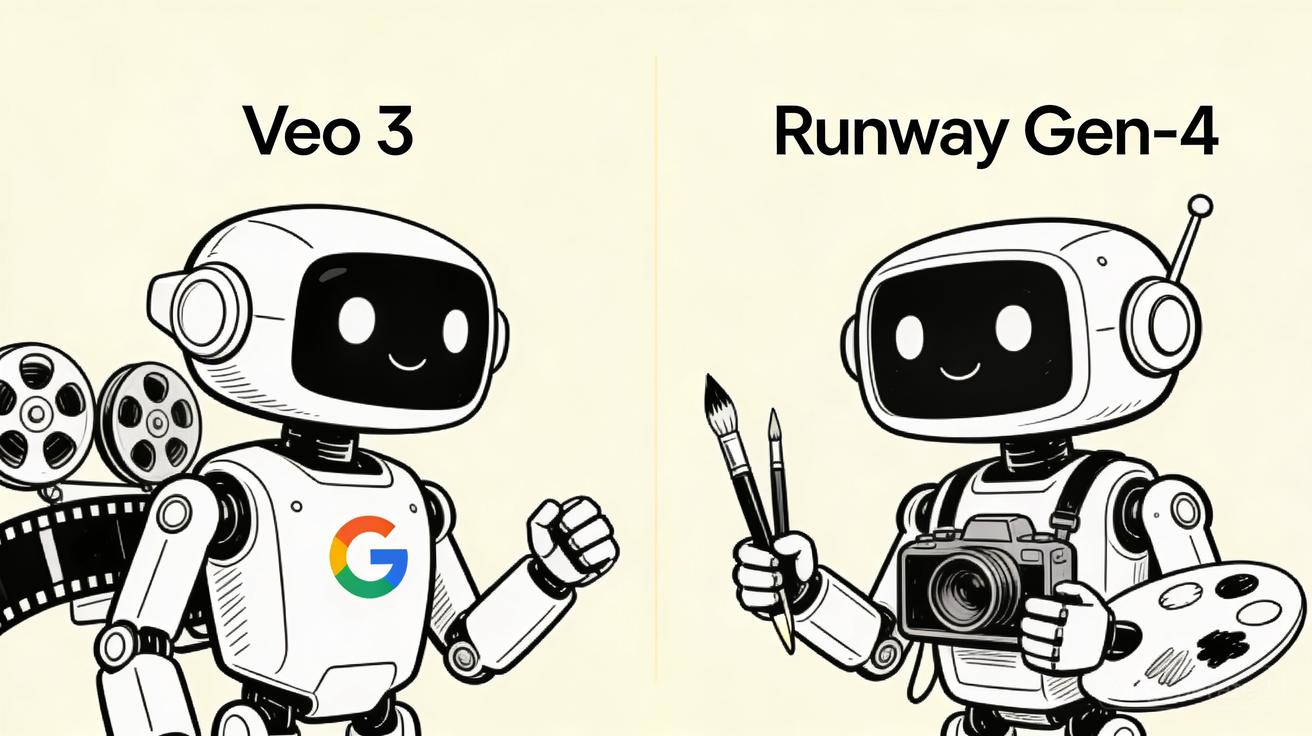
The landscape of generative video has shifted dramatically in 2026. At VeoNano, we track these advancements to help creators choose the right engine for their production pipeline. Today, the competition centers on two titans: Google’s Veo 3 and Runway’s Gen-4. While both offer groundbreaking capabilities, they serve distinct roles in a professional workflow.
What is Veo 3?
Veo 3 is Google’s most sophisticated leap into AI video to date. Originally unveiled at Google I/O, it has been deeply integrated into the Vertex AI ecosystem. It is designed for high-fidelity output, building on years of research to provide a seamless bridge between text prompts and cinematic reality.

What is Runway Gen-4?
Runway continues its legacy as a pioneer for creative professionals. Gen-4 is the fourth major iteration of their video technology, evolving from a simple generator into a comprehensive creative suite. It focuses on giving the user granular control over every frame, ensuring that the AI acts as a collaborator rather than just a black-box generator.
Head-to-Head: Key Features and Capabilities
When comparing these two powerhouses, the "winner" depends entirely on your specific project requirements.
Video Quality and Realism
Veo 3 is the current leader for "cinema-quality" visuals. It supports 1080p resolution with professional-grade color grading and realistic physics. It is particularly adept at handling complex lighting, architectural details, and macro photography. If your goal is a photorealistic product commercial or a high-end architectural walkthrough, Veo 3 provides the necessary environmental realism.
Motion Consistency and Physics
One of the greatest hurdles in AI video is temporal coherence—preventing objects from "morphing" over time. Veo 3 excels at maintaining consistent physics across a sequence. However, Runway Gen-4 counters this with its specialized toolset.
Editing Features and Control
This is where Runway Gen-4 pulls ahead. It isn't just about the raw generation; it’s about the suite of tools like Motion Brush, which allows you to direct specific movements within a scene. With built-in inpainting, green screen removal, and camera controls, Gen-4 allows creators to stay within one platform rather than jumping between multiple post-production apps.
Use Case Recommendations
- Choose Veo 3 if: You need maximum photorealism for marketing, high-end visualizations, or projects where lighting and environmental accuracy are non-negotiable. It is the "set it and forget it" choice for high-quality cinematic clips.
- Choose Runway Gen-4 if: You are a director or editor who needs precise control. If you need to animate a specific part of an image or require deep integration with a professional editing workflow, Gen-4’s flexibility is unmatched.
Pricing and Value
The cost structures reflect their target audiences. Veo 3 is often tied to Google’s enterprise-level cloud pricing via Vertex AI, making it a powerful choice for large-scale corporate projects. Runway Gen-4 typically follows a subscription model tailored to independent creators and creative agencies who need constant access to a wide array of manipulation tools.
Final Verdict
In 2026, the choice between Veo 3 and Runway Gen-4 isn't about which is "better," but which fits your role. Veo 3 is the master of the "final look," producing breathtaking realism with minimal effort. Runway Gen-4 is the ultimate "creator’s workbench," offering the tools needed to refine a vision until it is perfect.
At VeoNano, we recommend standardizing your workflow by using Veo 3 for raw asset generation and Runway Gen-4 for specific creative adjustments and motion control.
Next Step
Optimize your production with VeoNano workflow templates.
FAQs
1) Which model is faster for quick iterations? While both have improved generation speeds, Runway Gen-4 is often preferred for rapid iteration due to its integrated editing tools that allow for quick fixes without re-generating the entire clip.
2) Can I use my own images as a starting point? Yes, both platforms have robust Image-to-Video capabilities. Veo 3 focuses on maintaining the photographic integrity of the source, while Gen-4 provides more tools to control how that image moves.
3) Is 4K video generation available? As of 2026, both models focus on high-bitrate 1080p as the standard for stability, though upscaling workflows within the VeoNano ecosystem can bring these outputs to 4K for professional delivery.